

Announcement

Academicians Campus Tour: Professor Jin-Guang Teng Visits St. Francis' Canossian College to Share Insights on Reform and Opening-Up, Academic Journey, and Frontier Engineering Research
2026-02-27
On 6 February, 2026, the "Academicians Campus Tour," organised by The Greater Bay Area Association of Academicians (GBAAA), took place at St. Francis' Canossian College. Professor Jin-Guang Teng , Vice Chair of the GBAAA, Academician of the Chinese Academy of Sciences, and President of The Hong Kong Polytechnic University (PolyU), was invited to deliver a keynote lecture titled "The Nation's Reform and Opening-Up and My Academic Career." He shared his personal growth and scientific research journey with teachers and students, exploring the deep connections between technology, engineering, and the mission of youth from a perspective of national development.
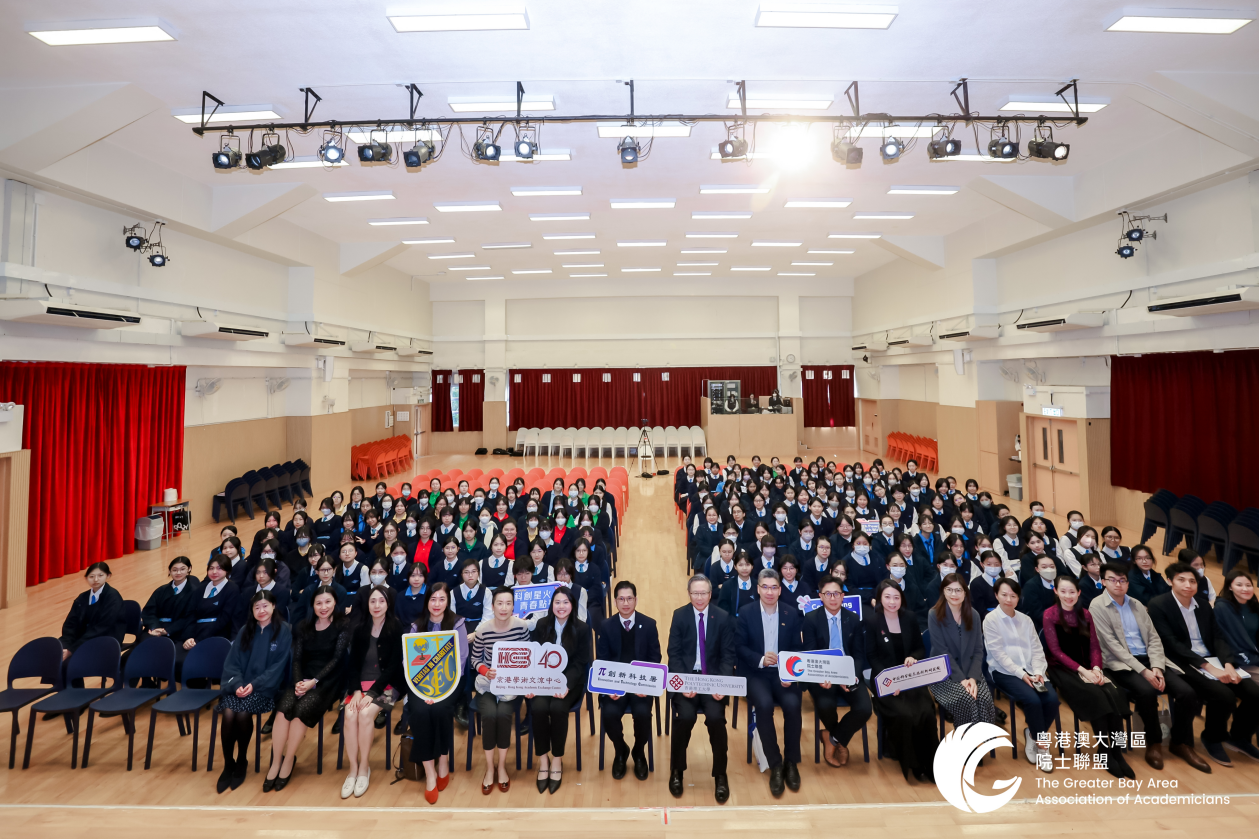
Prfofessor Teng with All Teachers and Students
During the lecture, Professor Teng reviewed pivotal moments in modern Chinese history and the milestone process of the Reform and Opening-Up, pointing out that the policy initiated in 1978 laid a critical foundation for the nation's economic, educational, and technological development. Through various statistical comparisons, he demonstrated China's leapfrog achievements in GDP, per capita income, and the popularisation rate of higher education. He emphasised that the Reform and Opening-Up not only profoundly transformed the country but also created invaluable opportunities for countless young people to change their lives through education and scientific research.
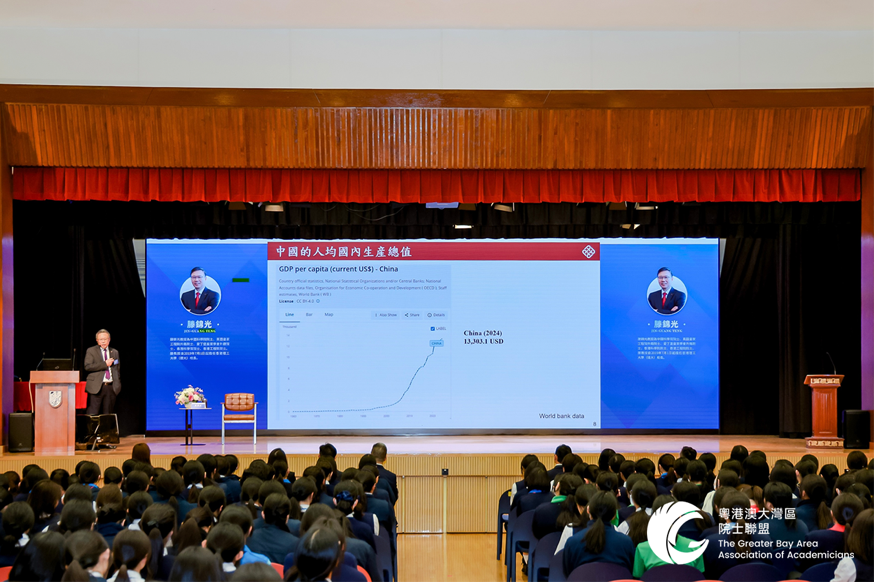
Professor Teng: Reform and Opening-Up Laid Country’s Development Foundation
Sharing his personal journey, Professor Teng recalled his student days in Yongjia County, Wenzhou, Zhejiang Province. He reminisced about entering Zhejiang University after the resumption of the National College Entrance Examination and his subsequent experience studying abroad under a government-sponsored scholarship from the Ministry of Education. He noted that an individual's academic path is closely intertwined with national development. It is the opportunities bestowed by the era that enable researchers to delve deeply into their fields and give back to society.
In the realm of scientific research, Professor Teng focused on his work in the application of advanced composite materials in civil engineering. He shared PolyU's cutting-edge research achievements in fiber-reinforced polymer (FRP) composites utilised with seawater sea-sand concrete structures. He noted that steel corrosion in traditional reinforced concrete structures is a severe issue, causing economic losses that can exceed 3% of GDP. Combining composites with seawater and sea-sand concrete not only substantially enhances structural durability and sustainability but also helps reduce costs, holding immense engineering and social value for coastal and marine engineering. Furthermore, Professor Teng shared his experience in driving scientific research and university development at PolyU, highlighting the university's remarkable progress in recent years regarding research strength, subject rankings, knowledge transfer, and the construction of research platforms in the Mainland, underscores the vital role universities play in serving national development and promoting technological innovation.
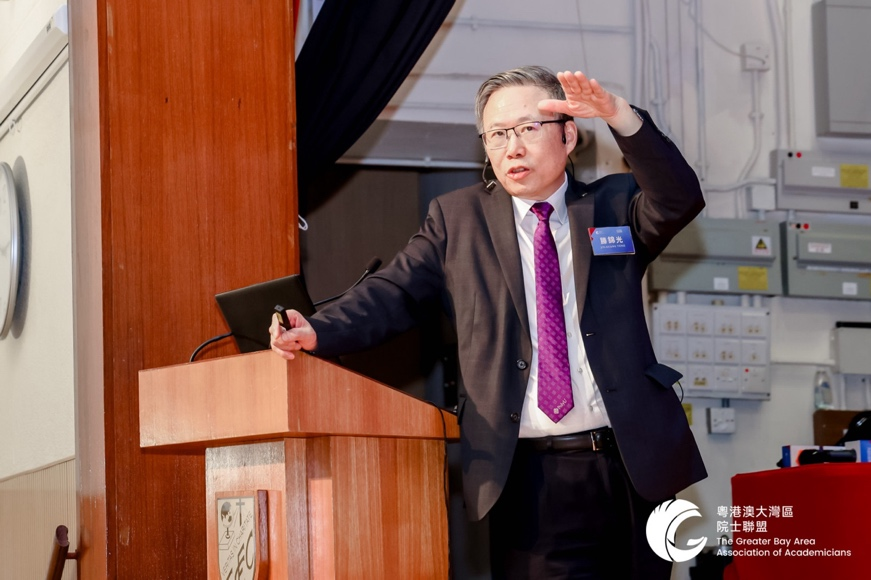
Professor Teng
During the Q&A session, students eagerly raised questions on topics such as "how to deal with learning difficulties and anxiety while absorbing knowledge" and "how to sustain innovative drive on the path of scientific research and professional development." Drawing from his own academic and research experiences, Professor Teng responded that when facing academic pressure, the key is to do one's best and avoid over-magnifying temporary gains and losses; when feeling lost, one should proactively communicate with teachers and mentors to gain perspective and support.
Regarding research and innovation, Professor Teng emphasised that innovation is not just about "being different," but should balance originality with actual impact, prompting researchers to reflect on the true value of their work and ask themselves, "Why does this need to be done by me?" When asked "how individual efforts can gradually influence society and the world," he pointed out that the meaning of life exists on multiple levels—ranging from doing one's duty well to giving back to society. Transforming the world often stems from long-term accumulation, professional dedication, and a sense of responsibility, rather than happening overnight.
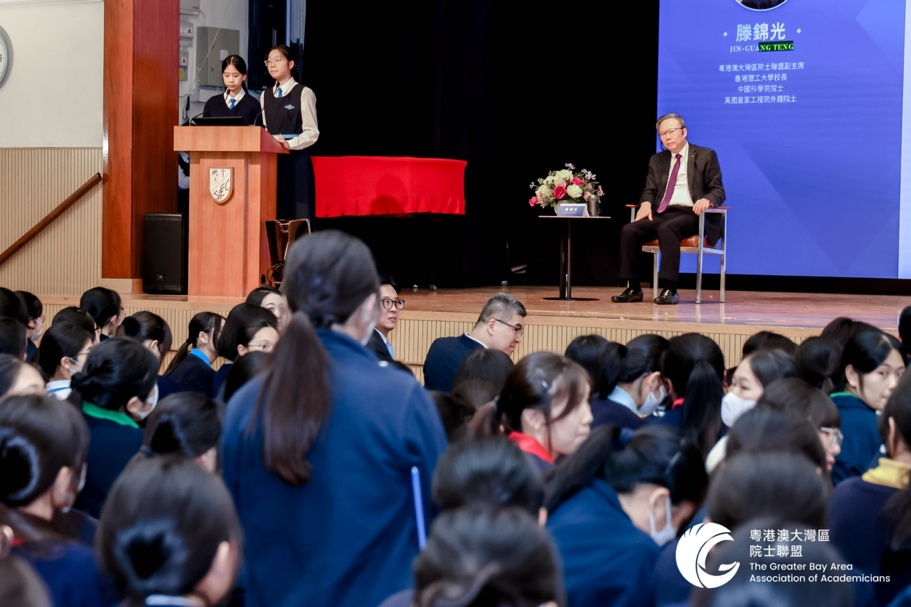

Exchange Session
This "GBAAA Academicians Campus Tour" was enriching and inspiring. It not only provided teachers and students with a deep understanding of the context of technological and engineering development against the backdrop of the Reform and Opening-Up, but also encouraged the younger generation to respond to the needs of the times with a grounded attitude, closely integrating personal growth with societal development to contribute to a sustainable future for the nation and the world.
About the GBAAA "Academicians Campus Tour" Initiative
As a pivotal platform for nurturing innovation and technology talents in the Guangdong-Hong Kong-Macao Greater Bay Area, GBAAA launched the "Academicians Campus Tour" initiative this year. The program invites academicians from both the Chinese Academy of Sciences and the Chinese Academy of Engineering to visit campuses, delivering scientific knowledge and promoting the spirit of science among youth through thematic lectures and face-to-face exchanges. The "Academicians Campus Tour" not only allows students to experience the charisma of top-tier scientists up close but also provides them with deeper insights into the nation's latest achievements in fundamental sciences, engineering technologies, life and medical sciences, and sustainable urban development. This initiative helps broaden their horizons in cutting-edge technology, strengthen their confidence in innovation, and cultivates a new generation of talent to support Hong Kong’s vision of becoming an international innovation and technology centre.