

Announcement

Academicians Campus Tour: Professor Anthony G.O. YEH Guides Students of Ho Ngai College to Explore the Present and Future of Smart Cities
2026-02-12
On the afternoon of February 4, 2026, the "Academicians Campus Tour", organised by The Greater Bay Area Association of Academicians (GBAAA), visited Ho Ngai College (Sponsored by Sik Sik Yuen). The event specially invited Professor Anthony G.O. YEH, an academician of the Chinese Academy of Sciences and Chair Professor of the Department of Urban Planning and Design at The University of Hong Kong, to deliver a thematic lecture titled "GIS-Enabled Smart Cities" to the teachers and students.
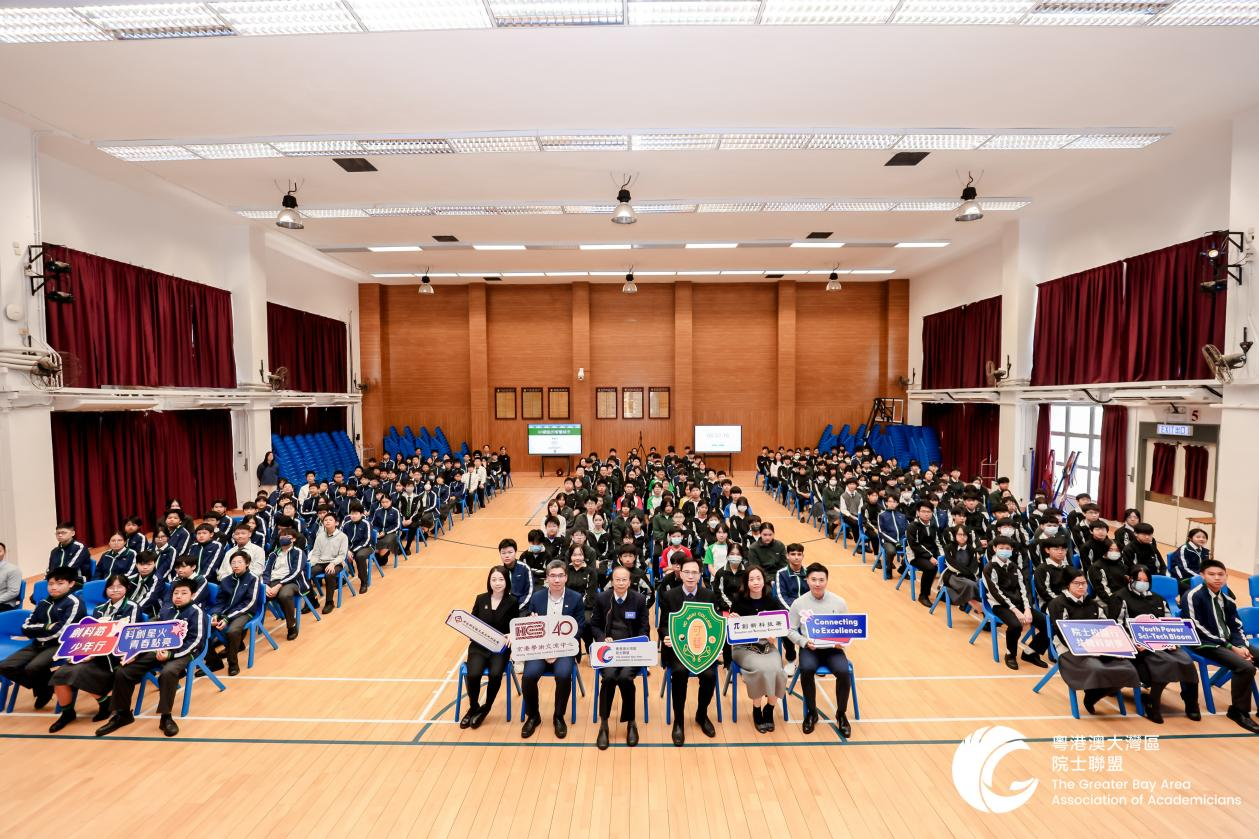
Professor Yeh with All Teachers and Students
Starting with the core role of GIS (Geographic Information Systems) in smart cities, Professor Yeh systematically explained the theoretical framework and practical pathways of GIS, drawing from his extensive experience in urban research across Hong Kong, Chinese Mainland, and Southeast Asia. Using wetland planning as an example, he demonstrated how map overlay analysis can evaluate the sensitivity of factories and residential areas to wetlands to generate wetland zoning maps, fully illustrating the practical value and technical advantages of GIS in urban planning. Building upon this, Professor Yeh expanded the discussion to the overall framework of smart cities, pointing out that the core of a smart city lies in the integrated application of sensors, information, and related information technologies. When discussing new trends in GIS development, Professor Yeh utilised intuitive flowcharts to showcase the operational systems of digital twin cities. He introduced students to new development directions such as 3D GIS and digital twin cities, deeply instilling in them the idea that future urban research will move toward deep multidisciplinary integration.
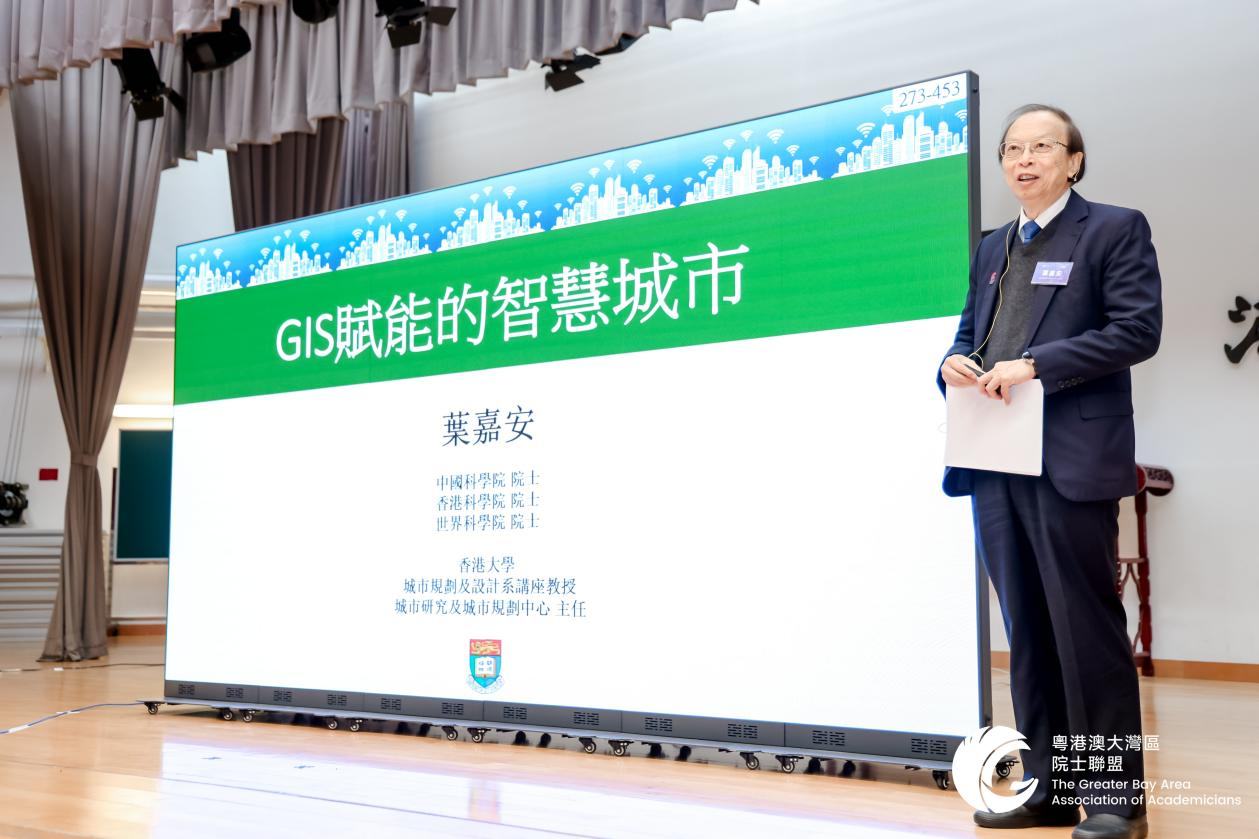
Professor Yeh
During the Q&A session, a student asked, "What role does GIS play in daily life?" Professor Yeh connected his answer to everyday scenarios familiar to the students, noting that GIS is used not only for navigation and location searches but can also assist in commercial site selection and urban spatial assessments through data analysis, helping people uncover potential opportunities outside of existing service coverages. Regarding the question, "Will the application prospects of the deep integration of AI and GIS affect future human career development?" He pointed out that when AI serves as a tool for humans, humans can still maintain a dominant position; however, if we rely too heavily on AI for decision-making, humanity will become dull. He emphasised that humans cannot fully hand over decision-making power to AI. Instead, while utilising AI, we must understand, analyse, and screen the information it provides to form independent cognitive and value judgment capabilities. Professor Yeh further used the legal profession as an example, noting that AI can efficiently collect and organise vast amounts of case information in a short time, providing strong support for professional work; however, over-reliance on AI could lead to misjudgments and risks. Although AI can offer inspiring and innovative ideas, ultimate decisions and responsibilities must still be borne by humans. Finally, he encouraged the young students to make good use of AI in the future rather than blindly relying on its conclusions, and to maintain their capacity for independent thinking and professional judgment amid the waves of technological advancement.
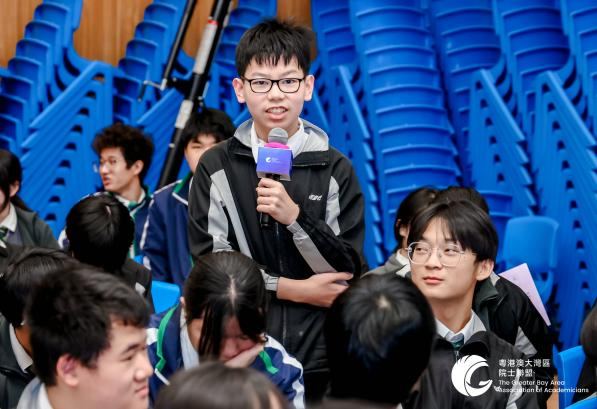
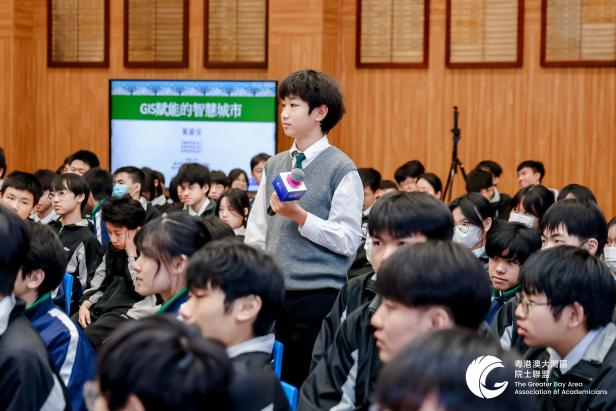
Q&A Session
In this lecture, Professor Yeh shared the students with the inspiring message: "Read extensively to understand humanity, think masterfully to manage world affairs" (廣讀人間書,妙理天下事). He encouraged everyone to build a solid discipline foundation, pay attention to social and urban development, and cultivate observation skills and problem awareness from daily life scenarios. Professor Yeh's profound scholarship and forward-looking vision not only deepened the students' understanding of GIS and smart cities, but also broadened their technological horizons, inspiring the entire audience to integrate academic knowledge with social development.
About the GBAAA "Academicians Campus Tour" Initiative
As a pivotal platform for nurturing innovation and technology talents in the Guangdong-Hong Kong-Macao Greater Bay Area, GBAAA launched the "Academicians Campus Tour" initiative this year. The program invites academicians from both the Chinese Academy of Sciences and the Chinese Academy of Engineering to visit campuses, delivering scientific knowledge and promoting the spirit of science among youth through thematic lectures and face-to-face exchanges. The "Academicians Campus Tour" not only allows students to experience the charisma of top-tier scientists up close but also provides them with deeper insights into the nation's latest achievements in fundamental sciences, engineering technologies, life and medical sciences, and sustainable urban development. This initiative helps broaden their horizons in cutting-edge technology, strengthen their confidence in innovation, and cultivates a new generation of talent to support Hong Kong’s vision of becoming an international innovation and technology centre.